
10/26/2026

Good afternoon. After what can only be described as a “breather week”, where just three European ABS deals were priced (one of which was pre-placed/retained), there was some regulatory news to keep us on our toes.
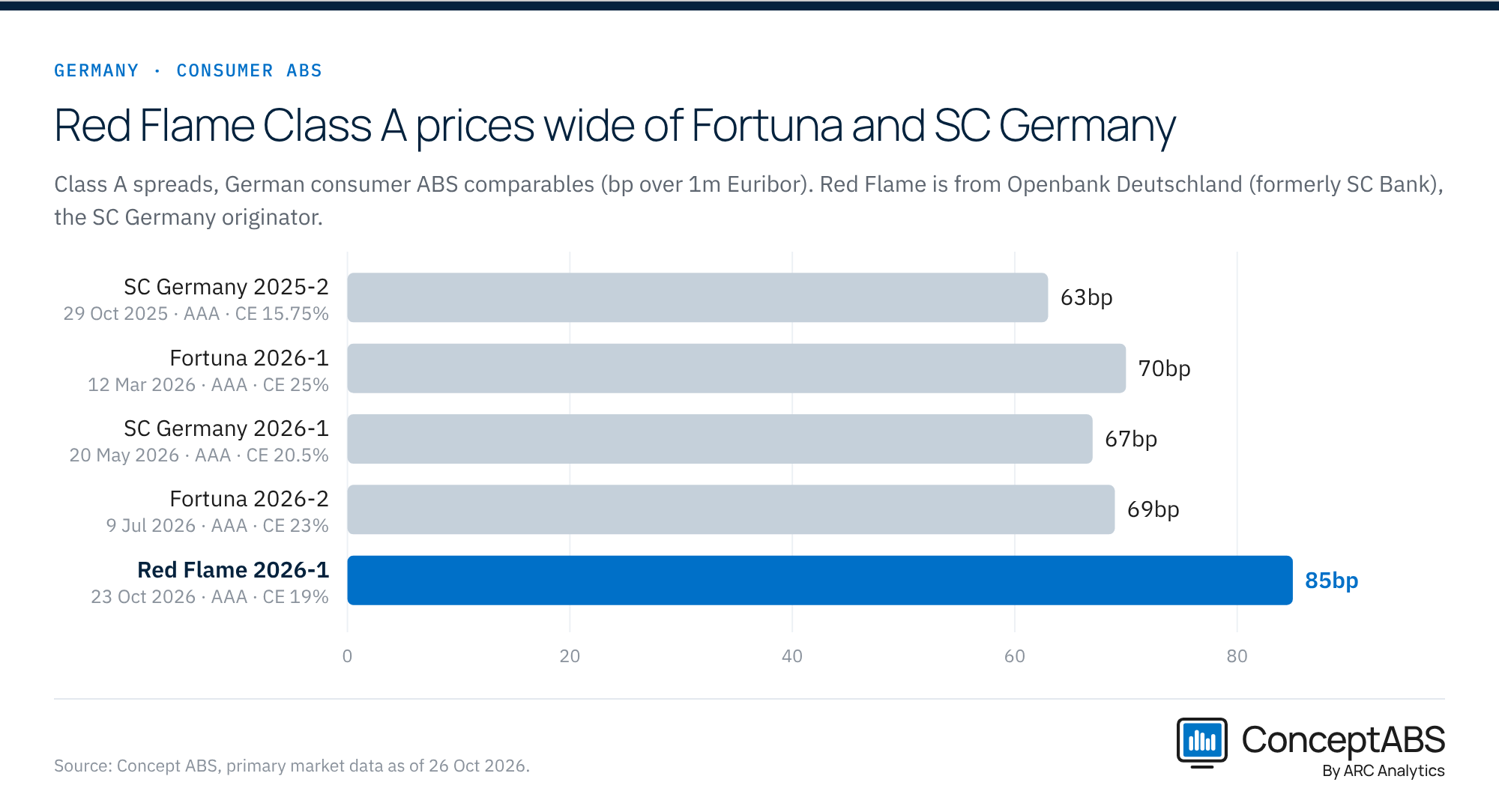
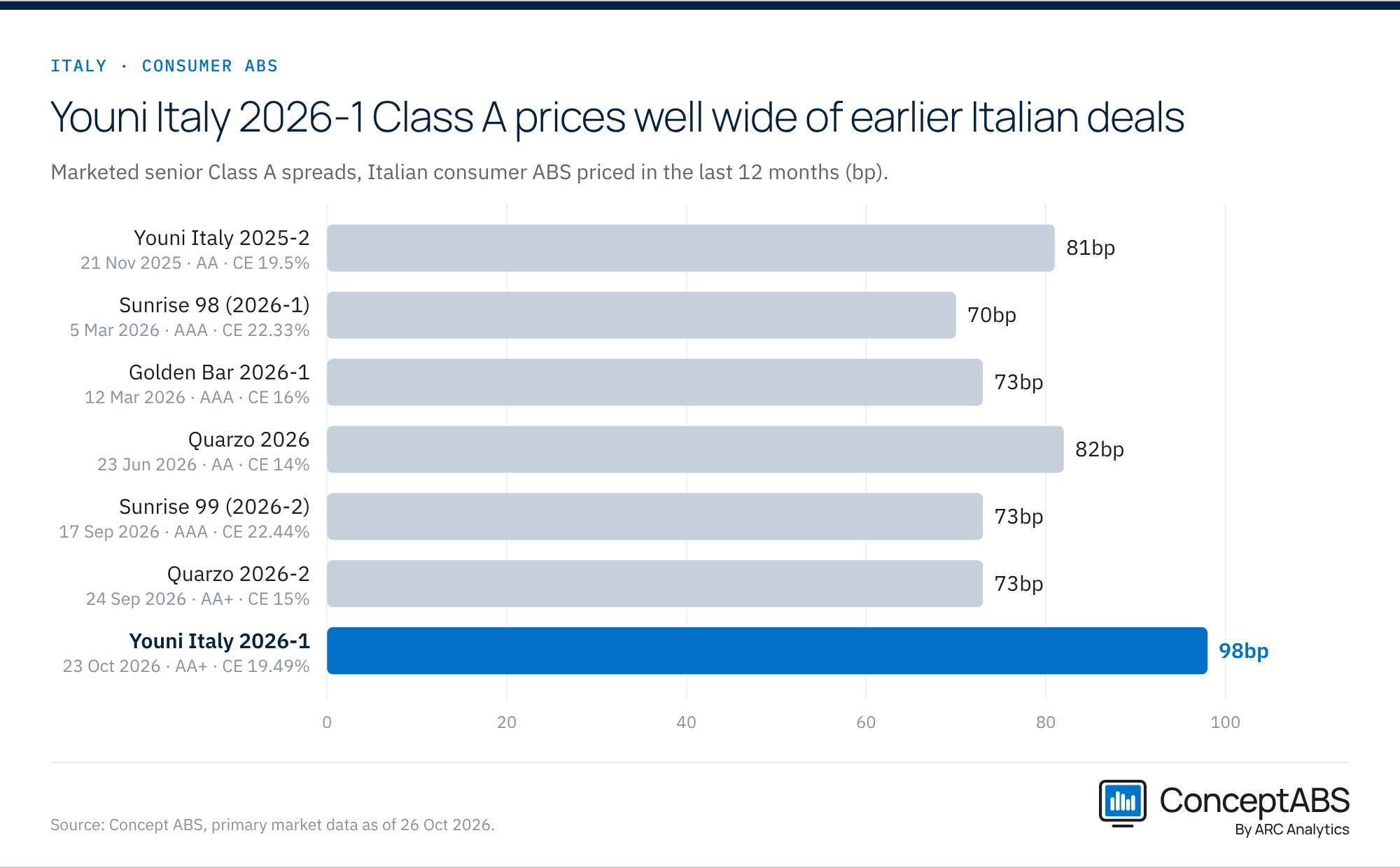
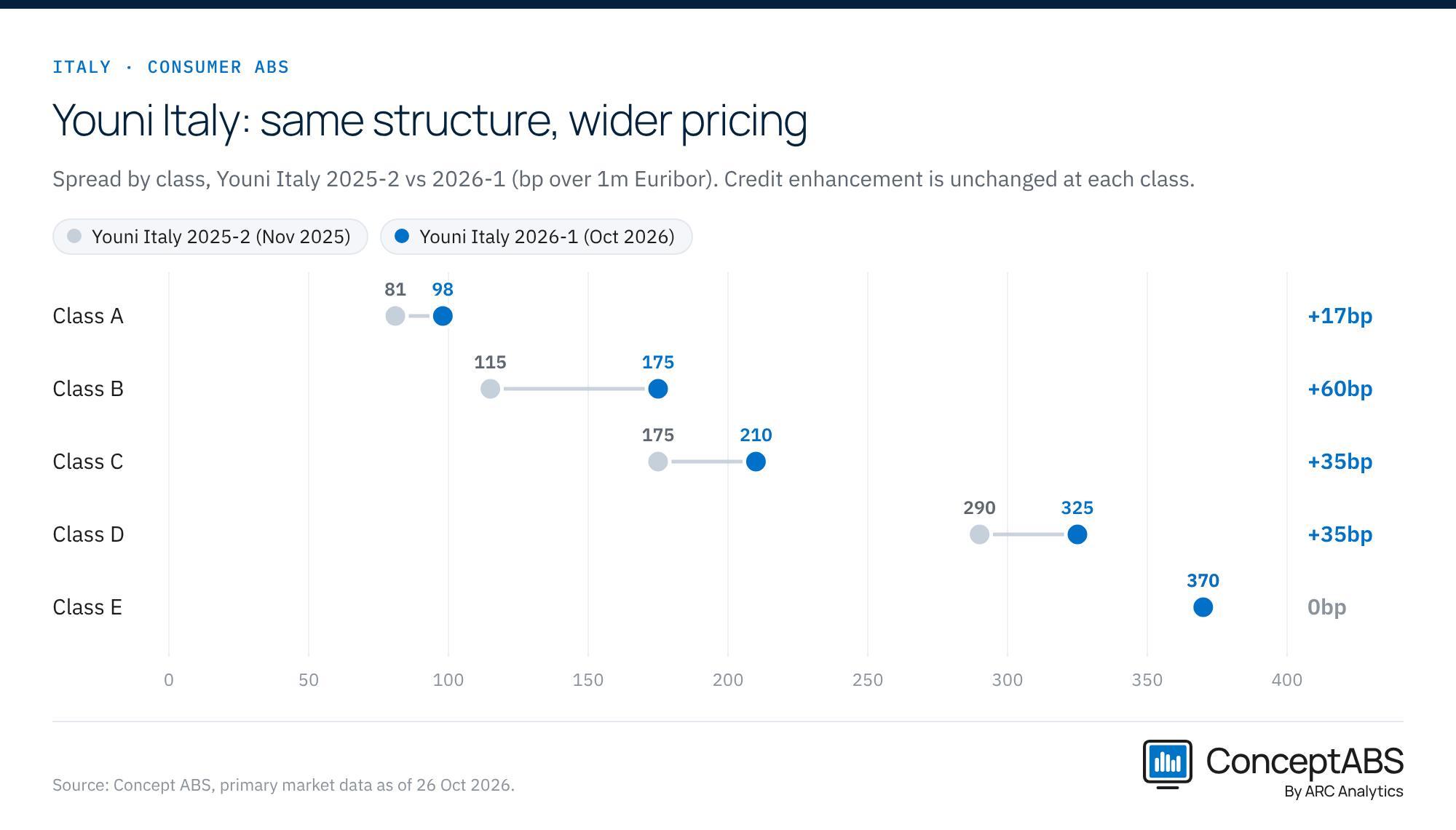
More on that later, but firstly to the deals which did price. The two offered trades were from Openbank Deutscheland (formerly known as Santander Consumer) with a €600m consumer ABS, now known as Red Flame 2026-1. Younited Credit priced yet another of its Italian consumer deals, the €233m eponymous Youni Italy 2026-1.
As we’ve touched on recently, the market is suffering from a bit of indigestion. The more we look at it, the more it feels fueled by ABS-specific factors rather than some sort of broader sense of fear from all the geopolitical and macroeconomic noise out there.
But nevertheless, the market at the triple-A level is clearly about 15bps wider than it was at the start of September, as both Younited Credit and Openbank Deutschland found out.
And it highlights one of the key things the EU’s reforms need to do well – get more investors into the market.
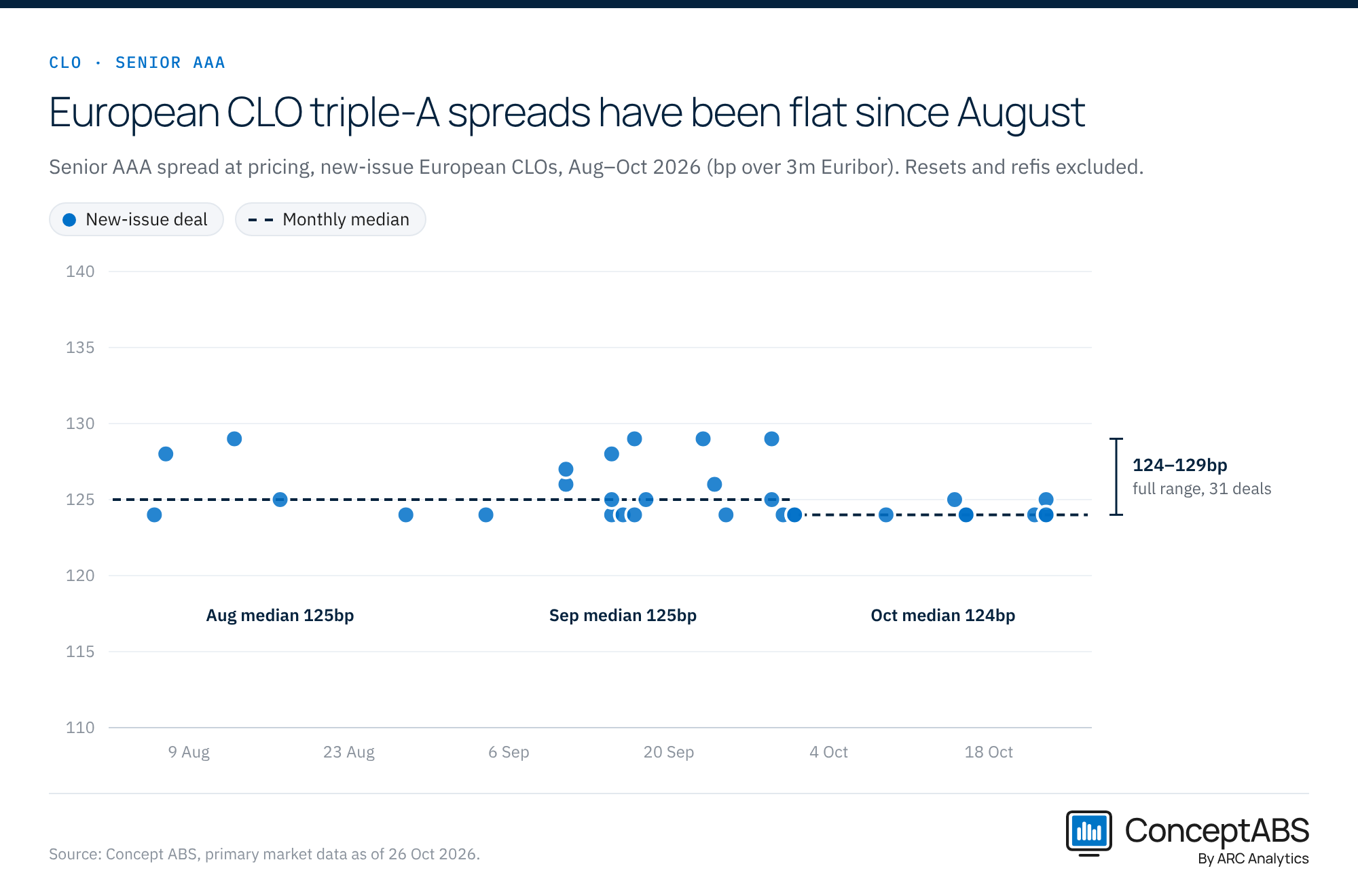
CLO triple-A pricing has stayed pretty flat in the last few months, hovering around 125bps. It is also floating rate, but is much more liquid than most of the ABS asset classes. Bankers have frequently told me that in sterling ABS, you only need two to three senior investors to say they’re not playing this week for your deal to be in real trouble. In euros, that number is maybe five. But the ending is the same. If suddenly accounts need a bit of a breather, the only way for your spread is up.
And we should remember that for many non-bank issuers, those basis points are not immaterial. On a €500m triple-A tranche, each basis point is worth roughly €50,000 per year. So, should you price 10bps wide of where you hoped, that could be a €500k hit to your business every year in funding costs.
Not because there’s something wrong with your underwriting skills or your business or even because of the broader macroeconomic picture. It’s just because there are not enough investors in the market this week. Whatever the reasons behind the regulations we have, that surely cannot be a good policy outcome.
So, progress on regulatory reforms cannot come soon enough, and there does appear to be light at the end of the tunnel. The EU Parliament has reached “provisional political agreement” with the EU Council on its mission to “revitalize and simplify” the EU’s securitization market.
The details are yet to be agreed, and so there is very little public or official information about what’s been agreed, but if you read between the lines of statements from the likes of AFME and various law firms, it seems the market is broadly happy with the proposals.
And as a result, I will not spend too much of this newsletter making jokes about the fact that EU policy makers think that they have simplified the market when their big idea is to add another layer on top of the simple, transparent and standardized (STS) label by creating “Resilient” securitizations. It’s simpler because there are more rules… obviously.
AFME’s statement, which you can read here, is broadly positive. I think they would have gone mad if the idea of a special sanctions regime just for securitization was included, so my guess is that it will get lawyered away in the final texts.
We always knew that the prudential part of the regulations would be the hardest to change, and that is where AFME are looking most set on continuing its advocacy. One issue developing is how the reforms seem to be particularly good if you’re the sort of big, regular triple-A/STS/master trust style issuer and not great for the rest.
As AFME said:
“STS securitisation accounts for only a portion of the overall European market, with non-STS securitisation continuing to support significant financing across the real economy. It is therefore disappointing that the reported agreement appears not to provide risk-weight floor caps for non-STS transactions, despite the higher ultimate floors applicable to those transactions.”
I asked Andrew Traynor, Partner and Co-Head of Finance & Capital Markets at law firm Walkers on his LinkedIn who he thought had got more of what they wanted in the negotiations. He rightly pointed out that a good deal is when no one walks away happy. But he added “the agreement has some positive developments but does seem to fall short of the transformative reform that many market participants had been hoping for.”
The good, he said, was progress on making it easier for UCITS funds to access the market, lower capital charges for banks on senior positions, and the resilient label (despite my jokes) is a good development. However, he added that CLOs distinct streamlined reporting template could become a problem – and it reflects a broader feeling of a “missed opportunity” by not embracing more principles-based approaches to due diligence.
We will have to wait and see on all the details. But this is coming relatively soon. Rabobank’s research pointed to the speedy process overall. So this could all be in force at some point next year.
A big additional point to mention is how much broader work on reforming the EU capital markets is due to take place in the coming years. Indeed, securitization is not being reformed in a vacuum, and there are so many places where those bigger changes to market competitiveness, the Savings and Investments Union plan (and many more) mean that one should not read this as the end of securitization reform. I think we could be talking of reform for another decade yet… By which point of course, we’ll be talking about ripping up the rules the EU’s just agreed. And so the cycle continues forever more.
In a record busting year for Euro denominated consumer loan collateral, a new German consumer ABS featuring originations from Openbank AG (formerly known as Santander Consumer Bank AG) has landed. Record supply in Euros in general in 2026 YTD is weighing on the bid. The last couple of weeks have shown that, with so much paper on offer, investors are pushing harder on pricing across the whole capital structure. Meanwhile, volatility in wider markets, geopolitical tensions, persistently high oil prices and weak government bond markets continue to cloud the outlook. Given all there was to contend with, the leads started...click here to read the full overview on Concept ABS.
European ABS primary looks set for a post-GFC record in placed issuance, with volumes so far this year already above €95bn against 2025's full-year total of €108.2bn. Consumer ABS is ahead of the curve, having already beaten its 2025 full-year record with over €16.5bn placed year-to-date. Add heavy secondary supply on top and investors have plenty to pick from, giving them the ability to be stubborn on pricing. The wider picture isn't much more reassuring. In the week before Red Flame priced, a higher-than-expected US inflation print for September stirred fears of rate hikes. Meanwhile, the ongoing Middle East conflict continues to keep oil prices elevated, stocks are wobbling as AI fears grow and global bond yields still look precarious (mutterings of a fresh Eurozone crisis are being heard with French bond yields hitting fresh 24 year highs, following unnerving street protests)...click here to read the full Market Context on Concept ABS.


© 2026 ARC Risk Models Limited

